Showing posts with label monster. Show all posts

Saturday, April 25, 2009

Bonnacon: Do not approach without a gasmask and a fire extinguisher!

“Hey,” says Mr. Bonnacon, “My poop is tougher than you!”


Here we have Mr. Bonnacon (bahn-ah-cahn), from a series I've done about mythological creatures. The bonnacon is a creature rarely seen these days. Most information on this species has passed to us from medieval manuscripts. A bull-like animal, with curly horns, it is carnivorous, preferring the flesh of domesticated animals- especially pets. For this reason, it has been hunted almost to extinction.

It has a peculiar method of defense: when approached, it expels a volley of flaming dung. These malodorous missiles can fly up to 100 yards, although there was one report of a particularly nasty bonnacon that could hurl dung for a mile. Do not approach this creature without a gas mask and a fire extinguisher!

Friday, April 24, 2009

Amphisbaena the Two-Headed Snake


“Hey,” says Mr. Amphisbaena, “Which end of me binges and which end purges?”
Here we have Mr. Amphisbaena (am-fis-bay-na), from a series I've done about mythological creatures. The amphisbaena is a two-headed lizard or serpent. It has one head in the normal position, and another at the end of its tail. It can therefore run in either direction. Its eyes shine like lamps, and it has no fear of cold.
I will leave it up to you to interpret the obvious symbolism concerning the duality of nature.
Historical References:
Lucan [1st century CE] (Pharsalia, book 9, verse 843-844): "Dread Amphisbaena with his double head / Tapering...".
Pliny the Elder [1st century CE] (Natural History, Book 8, 35): The amphisbaena has a twin head, that is one at the tail-end as well, as though it were not enough for poison to be poured out of one mouth.
Isidore of Seville [7th century CE] (Etymologies, Book 12, 4:20): The amphisbaena has two heads, one in the proper place and one in its tail. It can move in the direction of eaither head with a circular motion. Its eyes shine like lamps. Alone among snakes, the amphisbaena goes out in the cold.
**********************************************************
This paper doll comes with 26 parts, including a wheel, a unicycle seat, and an undigested meal. I would consider this to be a project for an experienced paper doll constructor. This is NOT a doll for beginners. Cutting the hole for the wheel will require an exacto blade (not included).
**********************************************************
SPECIAL NOTES: I have designed a mythological beastie paper doll for every letter of the alphabet (for some letters I’ve been able to draw more than one). If you are interested in seeing any other beasts not yet listed please convo me. Shadow puppets are also available
This doll is not intended for children. It would probably give them nightmares, anyway. It is an art piece, made of paper, intended for display purposes, or for light, gentle play (such as that provided to fairies, nymphs and good witches). Keep away from ogres, trolls, carnivorous plants, carnival geeks, pixies and water creatures.

Saturday, April 18, 2009

Pooka! Pooka! Pooka!

The Pooka or Phooka is an Irish Goblin with a variety of beast like forms. He appears sometimes as a dog or a horse, or even a bull, and is generally jet black with blazing eyes. As a seemingly friendly, shaggy, sway backed pony, the Pooka may offer the unwary traveler a welcome lift; but it only leads to a wild and terrifying gallop across the wettest and most thorny country, eventually to end with rider dumped headlong into the mire or deposited in a ditch. In recent times a Pooka may appear as a large invisible rabbit, generally mischevious, but benevolent. The footsteps you hear behind you in the dark are usually the Pooka…

Friday, April 17, 2009

Xylophon

Xylophon: a reanimated skeleton, named for the sound they make as they rattle. An animated skeleton is a type of physically manifested undead often found in fantasy, horror fiction, and mythical art. Though most are human, they can also be from any creature or race found on Earth, Midgard, or Middlearth.
· Animated human skeletons have been the personification of death in Western culture since the Middle Ages.
· The Grim Reaper is often depicted as a hooded skeleton holding a scythe and occasionally an hourglass.
· Death as one of the biblical Four horsemen of the Apocalypse has been depicted as a skeleton riding a horse.
· Figurines and images of skeletons doing routine things are common in Mexico's Day of the Dead celebration where skulls symbolize life and their familiar circumstances invite levity. Undead skeletons play a more active, and less symbolic, role in modern fantasy fiction. Skeletons are creatures that have been summoned from beyond the grave. They are normally of fallen warriors on battles of long past.

Skeletons might be given 'life' by a more powerful undead or necromancer. Reanimated by dark magic powers; skeleton follow their master’s orders without questioning. They appear a mindless set of animated bones, brutal and virtually immune to a piercing attack that would only harm the flesh they lack. In many stories, legions of undead skeletons are raised as perfectly obedient and expendable foot-soldiers or guards. Since most skeletons are controlled by something else, they cannot make their own intelligent decisions, and can easily be led into ambushes, traps, or hazardous terrain.

Wednesday, April 15, 2009

Cyclops

In Greek mythology and later Roman mythology, a cyclops (pronounced /ˈsaɪklɒps/; Greek: Κύκλωψ, Kuklōps), is a member of a primordial race of giants, each with a single eye in the middle of its forehead. The classical plural is cyclopes (pronounced : /saɪˈkloʊpiːz/; Greek: Κύκλωπες, Kuklōpes), though the conventional plural cyclopses is also used in English. The name is widely thought to mean "circle-eyed".

The earliest Cyclopes were blacksmiths. They provided Zeus' thunderbolt, Hades' helmet of invisibility, and Poseidon's trident, and the gods used these weapons to defeat the Titans. Later Cyclopes were shepherds, such as the infamous Polyphemus, encountered by the hero Odysseus.

They are known to consume large quantities of mutton, cheese, goats milk and wine. Roasted or raw meat of any sort will suffice to please a Cyclops, but they tend to shy away from shish-ka-bob and any sort of flambé. Their poor housekeeping and lack of hygiene make them extremely unpopular hosts.

Sunday, April 12, 2009

First in a new series of paperdolls, Mr. Spider


Come see my new MythoBeastie Paperdoll, Mr. Spider at http://www.etsy.com/view_listing.php?listing_id=23599625

MythoBeastie PaperDolls for carnival geeks, Halloween freaks,and cryptozoologists.

Monday, April 6, 2009

Wyvern

Wyverns are dragons with one pair of wings and one pair of legs (usually front legs). In the past, there was more confusion about the number of wings and legs. Some authors used wyvern, cockatrice and lindworm interchangably, or to mean different things. This eventually standardized into the wyvern that is recognized today.

These dragons are common in heraldry. They can symbolize envy, war, pestilence and viciousness. A drop of their blood can give humans the ability to understand bird-speech. Their skin, if eaten, can impart knowledge of the natural world. Their claws make powerful taslimans.

A German tale from the 1200s tells of a lindworm that lived near Klagenfurt. Flooding threatened travelers along the river, and the presence of a dragon was blamed. A Duke offered a reward for anyone who could catch it, so some young men tied a bull to a chain, and when the lindworm swallowed the bull, it was hooked like a fish and killed.

In 1335, when the skull of a wooly rhinoceros was found in a cave nearby, it was believed to be the dragon's skull and is currently on display in Klagenfurt. You can also see the Lindwurm fountain in Neuer Platz at the city centre.

Wyverns are not as large or as intelligent as dragons. They do make fierce gaurdians. Some cryptozoologists have theorized that wyverns are evidence of surviving pterosaurs, a large flying reptile thought to have gone extinct around 65 million years ago. There are alleged sightings in remote areas of pterosaur-like creatures known as the Kongamato in Africa. But this may be a different species altogether.

Friday, April 3, 2009

Vampire ATC


Vampire myths go back to the dawn of time and occur in nearly every culture around the world. The variety of form is almost endless; red eyed monsters with green or pink hair in China; the Greek Lamia which has the upper body of a woman and the lower body of a winged serpent; vampire foxes in Japan; a head with trailing entrails known as the Penanggalang in Malaysia.
The vampires we are familiar with today, made famous by fiction and film, are largely based on Eastern European myths. The vampire myths of Europe originated in the far East, and were transported from places like China, Tibet and India with the trade caravans along the silk route to the Mediterranean. Here they spread out along the Black Sea coast to Greece, the Balkans and of course the Carpathian mountains, including Hungary and Transylvania.
Our modern concept of the vampire still retains original concepts (blood drinking, resurrection, nocturnal human-hunting) in common with the Eastern European myths. However many things we associate with vampires; the wearing of evening clothes, capes with tall collars, turning into bats, are modern inventions.
On the other hand, many features of the old myths such as the placing of millet or poppy seeds at the gravesite in order to keep the vampire occupied all night counting seeds rather than preying on passersby, have all but disappeared from modern fiction and film.
I was told as a child that witches and vampires could not enter a house unless invited. But I was also told that they could call to you in your sleep and trick you into bidding them welcome while you lay in a trance. The only thing preventing their entry was the screen on the door. Each opening had to counted so that the witch or vampire could divide their body into tiny enough particles to infiltrate the screen and gain entry.
I lost a lot of sleep as a child…

Thursday, April 2, 2009

Troll by parkerart


Trolls are closely related to orcs and ogres. Generally large and stupid, most lack the ability to speak, communicating through grunts and gestures. Some have been used as guardians and warriors, but training is an arduous task. Trolls are generally divided into sub-species: mountain trolls, river trolls, and forest trolls. All trolls travel at night, and must avoid the sunlight because it turns them into stone. If cornered by a troll, it is best to avoid physical confrontation. Outwitting them is easy enough for humans. Stalling them until daybreak is usually your best bet.

Friday, March 27, 2009

Faun ACEO by parkerart


The Fauns, are associated with Satyrs, but are known to be more gentle. They are mischievous creatures with the legs, ears and tail of a goat and the face and body of a handsome young man.


When they follow the god Faunus they can cause nightmares. When they follow the god Silenus, they are usually too drunk to cause anything but chaos and panic. Pan, the god of panic, was a faun. At times, they can be quite cheerful. Proficient on the Pan-flute, they are generous hosts.


Fauns prefer to consort with nymphs, but have occasionally chased farm girls and milk maids.

Monday, March 23, 2009

Basilisk by parkerart

The mythical king of the serpents. The basilisk, or cockatrice, is a creature that is born from a spherical, yolkless egg, laid during the days of Sirius (the Dog Star) by a seven-year-old rooster and hatched by a toad. The basilisk could have originated from the horned adder or hooded cobra from India. Pliny the Elder described it simply as a snake with a golden crown. By the Middle Ages, it had become a snake with the head of a cock, and sometimes with the head a human. In art, the basilisk symbolized the devil and the antichrist.

According to legend, there are two species of the creature. The first kind burns everything it approaches, and the second kind can kill every living thing with a mere glance. Both species are so dreadful that their breath wilts vegetation and shatters stones. It was even believed that if a man on horseback should try to kill it with a spear, the power of the poison conducted through the weapon would not only kill the rider, but the horse as well. The only way to kill a basilisk is by holding a mirror in front of its eyes, while avoiding to look directly at it. The moment the creature sees its own reflection, it will die of fright. However, even the basilisk has natural enemies. The weasel is immune to its glance and if it gets bitten it withdraws from the fight to eat some rue, the only plant that does not wither, and returns with renewed strength. A more dangerous enemy is the cock for should the basilisk hear it crow, it would die instantly.

The carcass of a basilisk was often hung in houses to keep spiders away. It was also used in the temples of Apollo and Diana, where no swallow ever dared to enter.

Saturday, March 21, 2009

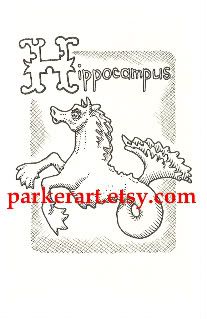
The hippocampus was a fabled sea animal from Greek mythology. It was found in classical myth. It resembles a horse with the hind parts of a fish or dolphin. The chariot of Poseidon was drawn by a hippocampus. The name comes from the Greek hippos, horse; and kampos, sea monster.