Showing posts with label myth. Show all posts

Saturday, April 25, 2009

Bonnacon: Do not approach without a gasmask and a fire extinguisher!

“Hey,” says Mr. Bonnacon, “My poop is tougher than you!”


Here we have Mr. Bonnacon (bahn-ah-cahn), from a series I've done about mythological creatures. The bonnacon is a creature rarely seen these days. Most information on this species has passed to us from medieval manuscripts. A bull-like animal, with curly horns, it is carnivorous, preferring the flesh of domesticated animals- especially pets. For this reason, it has been hunted almost to extinction.

It has a peculiar method of defense: when approached, it expels a volley of flaming dung. These malodorous missiles can fly up to 100 yards, although there was one report of a particularly nasty bonnacon that could hurl dung for a mile. Do not approach this creature without a gas mask and a fire extinguisher!

Friday, April 24, 2009

Amphisbaena the Two-Headed Snake


“Hey,” says Mr. Amphisbaena, “Which end of me binges and which end purges?”
Here we have Mr. Amphisbaena (am-fis-bay-na), from a series I've done about mythological creatures. The amphisbaena is a two-headed lizard or serpent. It has one head in the normal position, and another at the end of its tail. It can therefore run in either direction. Its eyes shine like lamps, and it has no fear of cold.
I will leave it up to you to interpret the obvious symbolism concerning the duality of nature.
Historical References:
Lucan [1st century CE] (Pharsalia, book 9, verse 843-844): "Dread Amphisbaena with his double head / Tapering...".
Pliny the Elder [1st century CE] (Natural History, Book 8, 35): The amphisbaena has a twin head, that is one at the tail-end as well, as though it were not enough for poison to be poured out of one mouth.
Isidore of Seville [7th century CE] (Etymologies, Book 12, 4:20): The amphisbaena has two heads, one in the proper place and one in its tail. It can move in the direction of eaither head with a circular motion. Its eyes shine like lamps. Alone among snakes, the amphisbaena goes out in the cold.
**********************************************************
This paper doll comes with 26 parts, including a wheel, a unicycle seat, and an undigested meal. I would consider this to be a project for an experienced paper doll constructor. This is NOT a doll for beginners. Cutting the hole for the wheel will require an exacto blade (not included).
**********************************************************
SPECIAL NOTES: I have designed a mythological beastie paper doll for every letter of the alphabet (for some letters I’ve been able to draw more than one). If you are interested in seeing any other beasts not yet listed please convo me. Shadow puppets are also available
This doll is not intended for children. It would probably give them nightmares, anyway. It is an art piece, made of paper, intended for display purposes, or for light, gentle play (such as that provided to fairies, nymphs and good witches). Keep away from ogres, trolls, carnivorous plants, carnival geeks, pixies and water creatures.

Saturday, April 18, 2009

Pooka! Pooka! Pooka!

The Pooka or Phooka is an Irish Goblin with a variety of beast like forms. He appears sometimes as a dog or a horse, or even a bull, and is generally jet black with blazing eyes. As a seemingly friendly, shaggy, sway backed pony, the Pooka may offer the unwary traveler a welcome lift; but it only leads to a wild and terrifying gallop across the wettest and most thorny country, eventually to end with rider dumped headlong into the mire or deposited in a ditch. In recent times a Pooka may appear as a large invisible rabbit, generally mischevious, but benevolent. The footsteps you hear behind you in the dark are usually the Pooka…

Friday, April 17, 2009

Xylophon

Xylophon: a reanimated skeleton, named for the sound they make as they rattle. An animated skeleton is a type of physically manifested undead often found in fantasy, horror fiction, and mythical art. Though most are human, they can also be from any creature or race found on Earth, Midgard, or Middlearth.
· Animated human skeletons have been the personification of death in Western culture since the Middle Ages.
· The Grim Reaper is often depicted as a hooded skeleton holding a scythe and occasionally an hourglass.
· Death as one of the biblical Four horsemen of the Apocalypse has been depicted as a skeleton riding a horse.
· Figurines and images of skeletons doing routine things are common in Mexico's Day of the Dead celebration where skulls symbolize life and their familiar circumstances invite levity. Undead skeletons play a more active, and less symbolic, role in modern fantasy fiction. Skeletons are creatures that have been summoned from beyond the grave. They are normally of fallen warriors on battles of long past.

Skeletons might be given 'life' by a more powerful undead or necromancer. Reanimated by dark magic powers; skeleton follow their master’s orders without questioning. They appear a mindless set of animated bones, brutal and virtually immune to a piercing attack that would only harm the flesh they lack. In many stories, legions of undead skeletons are raised as perfectly obedient and expendable foot-soldiers or guards. Since most skeletons are controlled by something else, they cannot make their own intelligent decisions, and can easily be led into ambushes, traps, or hazardous terrain.

Thursday, April 16, 2009

Brownies will clean for food...

A brownie/brounie or urisk (Lowland Scots) or brùnaidh, ùruisg, or gruagach (Scottish Gaelic) is a legendary kind of creature popular in folklore around Scotland and England (especially the north, though more commonly hobs play out their role). The Scandinavians call them tomte, the Slavic domovoi and the German Heinzelmännchen.

Customarily brownies inhabit the unused parts houses (attics, crawlspaces and wall pockets) and aid in tasks around the house. However, they don't like to be seen and will only work at night, traditionally in exchange for small gifts or food. They are particularly fond of porridge and honey. Many people (myself included) refuse to even dare sleep in a house where there is no milk, in fear of brownie reprisal. Brownies also will abandon a house if their gifts are called payments, or if the owners of the house misuse them. Some people also refer to them as Tommy-knockers, but it is generally agreed that brownies are mostly benevolent.

Wednesday, April 15, 2009

Cyclops

In Greek mythology and later Roman mythology, a cyclops (pronounced /ˈsaɪklɒps/; Greek: Κύκλωψ, Kuklōps), is a member of a primordial race of giants, each with a single eye in the middle of its forehead. The classical plural is cyclopes (pronounced : /saɪˈkloʊpiːz/; Greek: Κύκλωπες, Kuklōpes), though the conventional plural cyclopses is also used in English. The name is widely thought to mean "circle-eyed".

The earliest Cyclopes were blacksmiths. They provided Zeus' thunderbolt, Hades' helmet of invisibility, and Poseidon's trident, and the gods used these weapons to defeat the Titans. Later Cyclopes were shepherds, such as the infamous Polyphemus, encountered by the hero Odysseus.

They are known to consume large quantities of mutton, cheese, goats milk and wine. Roasted or raw meat of any sort will suffice to please a Cyclops, but they tend to shy away from shish-ka-bob and any sort of flambé. Their poor housekeeping and lack of hygiene make them extremely unpopular hosts.

Monday, April 13, 2009

Qilin

Qilin, also spelled Kylin, Keilun (in Cantonese), Kirin (also Girin in Korean), Kirin (in Japanese), Sabitun Sabintu (in Manchu), Kỳ lân (in Vietnamese) or Ki len (in Thai), is a mythical hooved creature that is said to appear in conjunction with the arrival of a sage. It is a good omen that brings rui ; roughly translated as "serenity" or "prosperity". It is often depicted with what looks like fire all over its body.

Although it looks fearsome, the Qilin only punishes the wicked. It can walk on grass and yet not trample the blades and it can also walk on water. Being a peaceful creature, its diet does not include flesh. It takes great care when it walks never to tread on any living thing, and it is said to appear only in areas ruled by a wise and benevolent leader (some say even if this area is only a house). It is normally gentle but can become fierce if a pure person is threatened by a sinner. Spouting flames from its mouth and exercising control of the weather are just a few of its powers.

Sunday, April 12, 2009

First in a new series of paperdolls, Mr. Spider


Come see my new MythoBeastie Paperdoll, Mr. Spider at http://www.etsy.com/view_listing.php?listing_id=23599625

MythoBeastie PaperDolls for carnival geeks, Halloween freaks,and cryptozoologists.

Sunday, April 5, 2009

Vespertilio


The Vespertilio, also known as Chauve-souris is a bird that gives birth to living young.
General Attributes:
The Vespertilio is not a noble bird. It is unlike other birds in that it gives birth to live young instead of laying eggs, and it has teeth. The Vespertilio gather together and hang from high places like a bunch of grapes; if one falls, all the rest also fall.
Sources (chronological order):
Pliny the Elder [1st century CE] (Natural History, Book 10, 81): The Vespertilio is the only flying creature that bears live young and feeds them with its milk; it also carries its children in its arms as it flies.
Isidore of Seville [7th century CE] (Etymologies, Book 12, 7:36): The Vespertilio, unlike other birds, is a flying quadruped, resembling a mouse. It has its name (vespertilio) from the time when it flies, after twilight. It flies about driven by precipitate motion, hangs from fragile branches, and makes a sound like a squeak.

Friday, April 3, 2009

Vampire ATC


Vampire myths go back to the dawn of time and occur in nearly every culture around the world. The variety of form is almost endless; red eyed monsters with green or pink hair in China; the Greek Lamia which has the upper body of a woman and the lower body of a winged serpent; vampire foxes in Japan; a head with trailing entrails known as the Penanggalang in Malaysia.
The vampires we are familiar with today, made famous by fiction and film, are largely based on Eastern European myths. The vampire myths of Europe originated in the far East, and were transported from places like China, Tibet and India with the trade caravans along the silk route to the Mediterranean. Here they spread out along the Black Sea coast to Greece, the Balkans and of course the Carpathian mountains, including Hungary and Transylvania.
Our modern concept of the vampire still retains original concepts (blood drinking, resurrection, nocturnal human-hunting) in common with the Eastern European myths. However many things we associate with vampires; the wearing of evening clothes, capes with tall collars, turning into bats, are modern inventions.
On the other hand, many features of the old myths such as the placing of millet or poppy seeds at the gravesite in order to keep the vampire occupied all night counting seeds rather than preying on passersby, have all but disappeared from modern fiction and film.
I was told as a child that witches and vampires could not enter a house unless invited. But I was also told that they could call to you in your sleep and trick you into bidding them welcome while you lay in a trance. The only thing preventing their entry was the screen on the door. Each opening had to counted so that the witch or vampire could divide their body into tiny enough particles to infiltrate the screen and gain entry.
I lost a lot of sleep as a child…

Thursday, April 2, 2009

Troll by parkerart


Trolls are closely related to orcs and ogres. Generally large and stupid, most lack the ability to speak, communicating through grunts and gestures. Some have been used as guardians and warriors, but training is an arduous task. Trolls are generally divided into sub-species: mountain trolls, river trolls, and forest trolls. All trolls travel at night, and must avoid the sunlight because it turns them into stone. If cornered by a troll, it is best to avoid physical confrontation. Outwitting them is easy enough for humans. Stalling them until daybreak is usually your best bet.

Thursday, March 26, 2009

Salamander by parkerart


ACEO Mythological Beastie 39 Salamander


An ACEO (Artist Trading Card (ATC), Edition Open), from a series I've drawn about mythological creatures.

The salamander (the name possibly coming from the Greek salambe meaning 'fireplace') was often visualized as a small dragon or lizard and is a fire elemental. According to Aristotle and Pliny, the salamander not only resisted fire, but could extinguish it and would charge any flame that it saw as if it were an enemy. Some thought that the reason the salamander was able to withstand and extinguish fire, was that it was incredibly cold, and it would put out fire on contact. The salamander was also considered to be very poisonous, so much so, that a person would die from eating the fruit form a tree around which a salamander had entwined itself.

Note:I have designed a mythological beastie card for every letter of the alphabet (for some letters I’ve been able to draw more than one). If you are interested in seeing any other beasts not yet listed please convo me.
Also note the watermark “parkerart.etsy.com” will not appear on your card.

Wednesday, March 25, 2009

Mandrake by parkerart

The mandrake, Mandragora officinarum, is a plant called by the Arabs luffâh, or beid el-jinn ("djinn's eggs"). The parsley-shaped root is often branched. Its’ leaves, 6 to 16 inches long, somewhat resemble those of the tobacco-plant. It grows a number of one-flowered nodding peduncles, bearing whitish-green flowers, nearly 2 inches broad, which produce globular, succulent, orange to red berries, resembling small tomatoes, which ripen in late spring. All parts of the mandrake plant are poisonous. The plant grows natively in southern and central Europe and in lands around the Mediterranean Sea, as well as on Corsica.

According to legend, when the root is dug up it screams and kills all who hear it. Literature includes complex directions for harvesting a mandrake root in relative safety. For example Josephus (c. 37 AD Jerusalem – c. 100) gives the following directions for pulling it up:A furrow must be dug around the root until its lower part is exposed, then a dog is tied to it, after which the person tying the dog must get away. The dog then endeavours to follow him, and so easily pulls up the root, but dies suddenly instead of his master. After this the root can be handled without fear.

Monday, March 23, 2009

Basilisk by parkerart

The mythical king of the serpents. The basilisk, or cockatrice, is a creature that is born from a spherical, yolkless egg, laid during the days of Sirius (the Dog Star) by a seven-year-old rooster and hatched by a toad. The basilisk could have originated from the horned adder or hooded cobra from India. Pliny the Elder described it simply as a snake with a golden crown. By the Middle Ages, it had become a snake with the head of a cock, and sometimes with the head a human. In art, the basilisk symbolized the devil and the antichrist.

According to legend, there are two species of the creature. The first kind burns everything it approaches, and the second kind can kill every living thing with a mere glance. Both species are so dreadful that their breath wilts vegetation and shatters stones. It was even believed that if a man on horseback should try to kill it with a spear, the power of the poison conducted through the weapon would not only kill the rider, but the horse as well. The only way to kill a basilisk is by holding a mirror in front of its eyes, while avoiding to look directly at it. The moment the creature sees its own reflection, it will die of fright. However, even the basilisk has natural enemies. The weasel is immune to its glance and if it gets bitten it withdraws from the fight to eat some rue, the only plant that does not wither, and returns with renewed strength. A more dangerous enemy is the cock for should the basilisk hear it crow, it would die instantly.

The carcass of a basilisk was often hung in houses to keep spiders away. It was also used in the temples of Apollo and Diana, where no swallow ever dared to enter.

Saturday, March 21, 2009

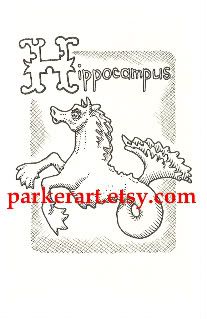
The hippocampus was a fabled sea animal from Greek mythology. It was found in classical myth. It resembles a horse with the hind parts of a fish or dolphin. The chariot of Poseidon was drawn by a hippocampus. The name comes from the Greek hippos, horse; and kampos, sea monster.

Wednesday, March 18, 2009

Gnome by parkerart


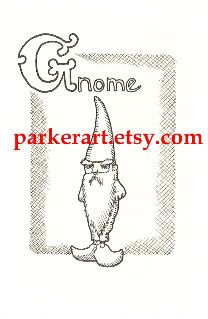
A gnome is a mythical creature characterized by its extremely small size and subterranean lifestyle. Due it’s scarcity and secretive habits, little is known about them. Some claim that they can disappear at will.Most are found in forested areas or along abandoned fencerows, but a few make homesteads at the ends of neglected gardens. Badgers, stouts, skunks, and serpents are their mortal enemies. Some gnomes have the ability to speak with birds, insects, fairies, and pixies. While they enjoy relationships with winged creatures, they specifically avoid humans, trolls, and ogres. Compatible with elves, gnomes are most comfortable with dwarves.

Sunday, March 15, 2009

THE GRIFFIN, OR GRYPHON

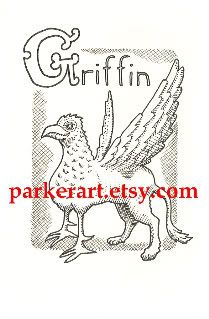
The Griffin is a monster with the body of a lion, the head and wings of an eagle, and back covered with feathers. Like birds it builds its nest, and instead of an egg lays an agate therein. It has long claws and talons of such a size that they are made into drinking-cups. India is assigned as the native country of the Griffins. The Griffins found gold in the mountains and built their nests of it, for which reason their nests were very tempting to the hunters, and they were forced to keep vigilant guard over them. Their instinct led them to know where buried treasures lay, and they did their best to keep plunderers at a distance. The Arimaspians were a one-eyed people of Scythia, famed for plundering the Griffin’s gold.

Milton borrows a simile from the Griffins, Paradise Lost, BookII.:

"As when a Gryphon through the wilderness,
With winged course, o'er hill and moory dale,
Pursues the Arimaspian who by stealth
Hath from his wakeful custody purloined
His guarded gold."

Saturday, March 14, 2009

Elf by parkerart

art, elf, atc, parkerart, myth
An ACEO (Artist Trading Card (ATC), Edition Open), from a series I've drawn about mythological creatures.

The elf is a creature of Germanic mythology. The elves were originally thought of as a race of minor nature and fertility gods, who are often pictured as youthful-seeming men and women of great beauty living in forests and underground places and caves, or in wells and springs. They have been portrayed to be long-lived or immortal and as beings of magical powers.

Following J. R. R. Tolkien's influential The Lord of the Rings, wherein a wise, immortal people named Elves have a significant role, elves became staple characters of modern fantasy. This card is designed to immulate Tolkien’s Elves.

Note:I have designed a mythological beastie card for every letter of the alphabet (for some letters I’ve been able to draw more than one). If you are interested in seeing any beasts visit www.parkerart.etsy.com